
November 17, 2026
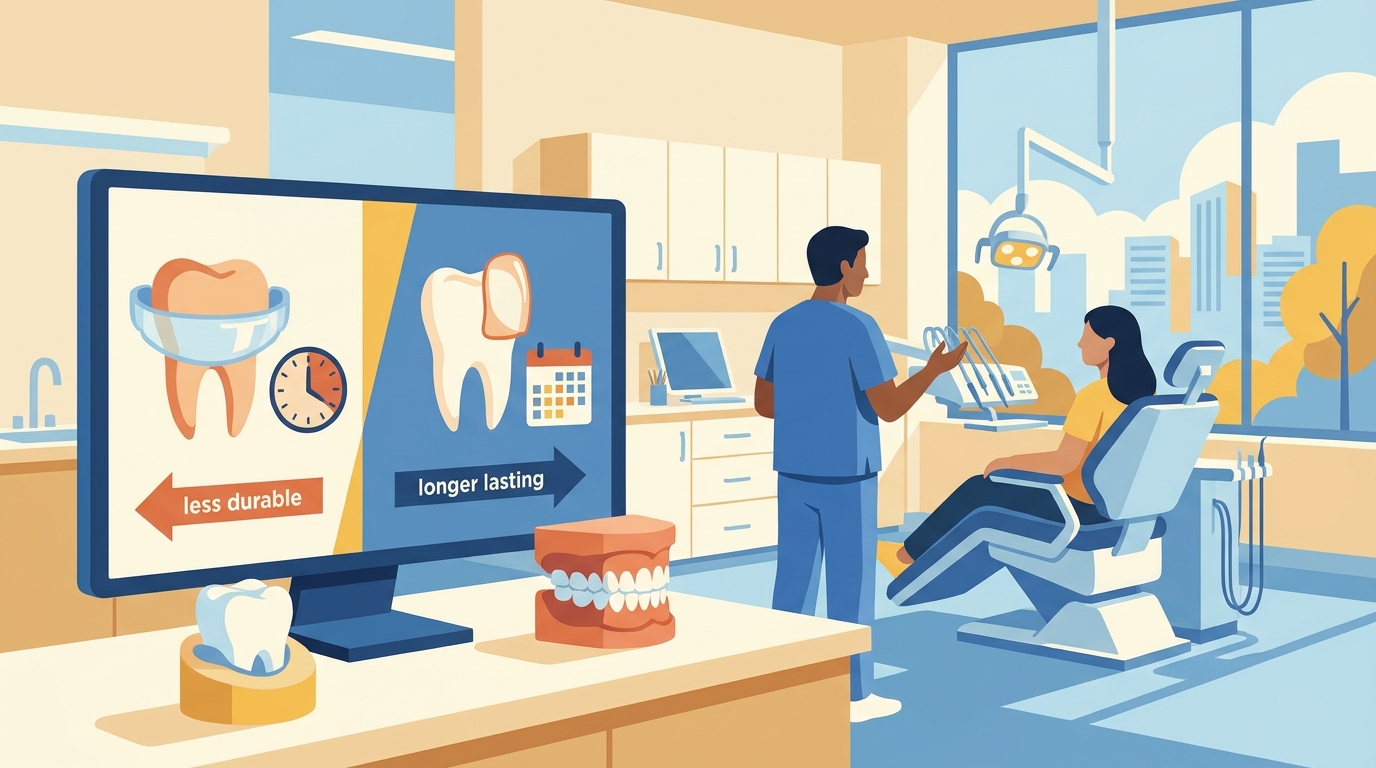
Porcelain veneers last longer than teeth whitening — full stop. Veneers are custom ceramic shells bonded to the front of your teeth and are built to be strong and long-lasting, while professional whitening lightens natural enamel and gradually fades as everyday staining returns. The right choice depends less on longevity alone and more on what you're actually trying to change: color only, or color plus shape, chips, and symmetry.
That's the honest answer. Now let's look under the hood at why each treatment behaves the way it does — and how to decide which one deserves your investment.
Professional whitening results typically hold for months to a few years, depending on the stain type, the delivery method, and your daily habits. The American Dental Association recognizes three routes — in-office bleaching, dentist-supplied take-home trays, and over-the-counter products — and each one lightens natural enamel rather than coating it, which is why color eventually drifts back. According to ADA guidance, effective whitening can last more than one year with adequate care, though outcomes vary by patient and habit.
Here's what's happening at the enamel level. Whitening gels rely on peroxide chemistry to break down stain molecules inside the tooth — and that process is also why some patients feel temporary sensitivity. Because whitening works on the inside of a natural tooth, results are reversible in both directions. Extrinsic stains from coffee, tea, red wine, cola, and tobacco rebuild on enamel over time. Intrinsic stains — the deeper kind — are harder to shift in the first place; some may require more intensive or prolonged treatment. The team at Atlanta Dental Spa — Brookhaven routinely walks patients through which category their discoloration falls into before recommending a protocol, because the honest answer to "how long will this last?" depends entirely on that distinction.
Porcelain veneers are described by the American Dental Association as strong, long-lasting, and natural-looking — but they are not indestructible. Over years of normal use they can chip, crack, wear down, or loosen, which means eventual repair or replacement is part of the deal. A well-made veneer on a well-maintained tooth, in a mouth without heavy grinding or a deep overbite, is a multi-year commitment. Estimates in the dental literature suggest a veneer may need replacement somewhere in the range of every several years to two decades, depending on care and bite forces — but these are estimates, not guarantees.
The durability comes from how a veneer is built and placed. It's a custom thin shell of porcelain, fabricated by a dental laboratory to fit the front surface of a specific tooth. To seat it, the dentist removes a small amount of enamel from the front and sides of the tooth so the veneer sits flush and bonds securely. That preparation is also what makes veneer treatment effectively irreversible — the enamel does not grow back.
There's an important structural distinction here: veneers cover only the front surface of a tooth, unlike crowns, which cover the entire tooth. That partial coverage is why veneers look so natural, but it's also why a healthy foundation matters. A dentist must first treat any decay or gum disease before placing veneers, because placing porcelain over an unhealthy tooth can worsen existing problems.
Only natural teeth can be whitened — not tooth-colored restorations. Porcelain doesn't respond to peroxide the way enamel does, so once a veneer is bonded, its shade is fixed for the life of that restoration. This single fact drives one of the biggest sequencing decisions in cosmetic dentistry.
If you plan to whiten your natural teeth and get veneers, the whitening generally comes first, and the veneers are then matched to your new, brighter baseline. Reverse the order and you lock in a shade that your surrounding natural teeth may eventually drift away from — especially as enamel ages.
Whitening is the better fit when your teeth are healthy, well-shaped, and well-aligned, and your only real complaint is color. Veneers are the better fit when you want to change color and shape, size, chips, or minor visible irregularities in a single treatment. The decision is less about which lasts longer and more about which actually solves your problem.
Whitening is also effective on both extrinsic and intrinsic staining when the right system is chosen, though some over-the-counter whitening products such as toothpastes and chewing gums are effective primarily on extrinsic stains and won't meaningfully move intrinsic discoloration. That gap between OTC and professional delivery is a large part of why in-office and dentist-supervised treatments produce more predictable results.
Veneers, by contrast, can address several issues at once but carry commitments whitening doesn't. They are considered cosmetic dentistry and may not be covered by insurance unless deemed medically necessary. If a patient clenches or grinds their teeth or has a deep overbite, veneers may not be a good choice — the forces involved can shorten their useful life.
Whitening is a short, non-surgical process; veneers involve lab fabrication and multiple appointments. In-office whitening uses a stronger peroxide concentration applied under supervision, with a typical appointment lasting about an hour according to ADA guidance; dentist-supplied trays deliver a lower-concentration gel at home over a longer period; and OTC products sit at the lowest concentration with the least customization.
For veneers, the process is sequential and permanent. The dentist first confirms the teeth are healthy, then removes a small amount of enamel from the front and sides of each tooth being treated. A digital scan or impression is sent to a dental laboratory, and a patient may have a temporary veneer while the permanent porcelain veneer is being made at the lab. Once ready, each veneer is tried in, adjusted, and bonded. Cosmetic planning sessions at Atlanta Dental Spa — Brookhaven are typically where patients work through shade selection, tooth shape, and whether whitening should be sequenced first.
Patients who have visited Atlanta Dental Spa — Brookhaven describe the experience in terms that reflect both the clinical quality and the environment. One customer wrote: "They have high tech facilities & equipment & patient care is at top." Another noted staff were "professional, welcoming and friendly" and "clear about treatment plans" — exactly the transparency that matters when making an irreversible cosmetic decision.
Professional whitening is generally worth the cost when you want predictable results on both extrinsic and intrinsic stains. Dentist-delivered systems use stronger, better-controlled peroxide concentrations than over-the-counter options, which are effective mainly on surface stains on enamel. A dentist can also screen for sensitivity triggers and restorations that won't respond to bleaching.
Porcelain veneers are considered strong and long-lasting, but they can chip, crack, wear down, or loosen over time, which means they may eventually need repair or replacement. Longevity depends on bite forces, hygiene, and whether habits like clenching or grinding are managed. Routine dental visits catch early wear before a full replacement is required.
You can whiten your remaining natural teeth, but the restorations won't change color. Only natural teeth respond to whitening — porcelain veneers, crowns, and other tooth-colored restorations keep whatever shade they were made in. If your natural teeth brighten significantly, the restorations may suddenly look darker by comparison, which is why sequencing matters.
Veneer placement is not reversible because a small amount of tooth enamel is removed from the front and sides of each tooth to make room for the porcelain shell. This isn't "damage" in the sense of harm when done correctly on a healthy tooth, but it is a permanent structural change. A dentist should treat any decay or gum disease before placing veneers.
With increasing age, enamel becomes more translucent and thinner, which allows the yellower dentin underneath to show through, causing overall tooth color to darken. Lifestyle factors stack on top of that: extrinsic discoloration is associated with tobacco use and consumption of highly pigmented foods or beverages such as red wine, coffee, tea, or cola drinks.
Temporary tooth sensitivity and gum irritation are recognized side effects of teeth whitening. These are usually short-lived and resolve after treatment ends, but they are worth discussing with a dentist beforehand — especially if you already experience sensitivity or have gum recession. Pre-existing cavities or gum disease should be addressed before whitening begins.
Both treatments vary considerably in cost depending on the number of teeth involved, the delivery method, the dental practice, and local market conditions. Veneers are typically quoted per tooth, so a multi-tooth plan compounds quickly. Whitening is generally the lower-cost option because it involves no lab fabrication or enamel preparation. For a current quote tailored to your situation, contact Atlanta Dental Spa — Brookhaven directly.
Both treatments are generally considered cosmetic and are not typically covered by dental insurance. Coverage may apply only if a procedure is deemed medically necessary, which is uncommon for elective whitening or veneers. Because plan terms vary, the best step is to verify your benefits directly with your insurer and discuss cost and payment options with Atlanta Dental Spa — Brookhaven before scheduling.
Porcelain veneers outlast whitening, but longevity isn't the real question — fit is. If your teeth are healthy and well-shaped and you just want them brighter, whitening is the less invasive, more affordable path, and you can repeat it as needed. If you want to reshape, repair, and recolor in one treatment and accept that the result is permanent, veneers are the tool built for that job.
Readers who want a professional assessment of which treatment actually matches their smile goals can reach Atlanta Dental Spa — Brookhaven at (404) 800-0140 or visit https://www.atlantadentalspa.com to start the conversation.